
Choosing an International School in Malaysia (2026)
Moving to Malaysia with children means making two big decisions at once – the visa, and the school. The good news: Malaysia has one of the largest international school scenes in Asia, at fees that surprise most families arriving from abroad.
The less good news: with well over a hundred schools across four major curricula, it's easy to feel overwhelmed by open days and countless glossy brochures.
To help you narrow down your options, you might want to consider these three questions:
1. Where is your child most likely to go to university? That decides the curriculum.
2. Where in Malaysia will you live? That decides your shortlist – the best school an hour away in KL traffic is probably still not the best school.
3. When are you arriving? That decides which intake you're aiming for, and how much time you actually have.
Once you’ve got that clear, consider which school system suits your child best:
The four main school systems
The British system
The British curriculum is the backbone of international schooling in Malaysia - more schools follow it than any other system, at every price point.
How it works
Children move through Years 1–13. The two milestones are IGCSEs, sat at around 16 after a two-year course, and A-Levels at around 18, where students specialise in three or four subjects.
A-Level results are the standard entry ticket to UK universities, and are accepted almost everywhere else – including Malaysian private universities, Australia, and (with some conversion) the US.
Who it suits
Families heading for UK universities, obviously – but also undecided families. Because it's so widely offered here, the British route gives you the most school choice, the easiest transfers between schools, and qualifications every university admissions office understands.
The IB (International Baccalaureate)
How it works
IB runs from the Primary Years Programme (PYP) through the Middle Years Programme (MYP) to the two-year Diploma Programme (DP), examined at 18. Instead of specialising early, students keep six subjects plus a core of critical-thinking work. It's rigorous, inquiry-led, and deliberately international – the same programme in KL as in Geneva or Tokyo.
Who it suits
Globally mobile families. If there's a real chance you'll relocate again before your child finishes school, the IB transfers more seamlessly than any national system. It also suits all-rounders who'd rather not narrow to three subjects at sixteen. Fewer schools offer it than the British route, and they cluster toward the premium end.
The Australian system
How it works
The Australian curriculum runs Foundation to Year 12, finishing with a senior secondary certificate and an ATAR ranking for university entry. Teaching style is close to the British model, with continuous assessment playing a bigger role.
The Australian school year runs January to December – not August to July like almost every other international school in Malaysia. For a family transferring mid-year, that half-year offset can mean your child effectively repeats or jumps six months. Sometimes that's a problem; sometimes it's actually the smoothest landing, depending on where in the year you arrive.
Who it suits
Families bound for Australian universities, or arriving from an Australian school. Note that dedicated Australian-curriculum schooling in Malaysia is essentially a one-school decision in the Klang Valley – you're choosing the school and the system together.
The American system
How it works
Grades 1–12, with no single leaving exam. Students build a GPA across their high-school years, take AP (Advanced Placement) courses for rigour, and sit the SAT or ACT for university admission. Assessment is continuous – coursework, participation, and projects matter as much as exams.
Who it suits
Families with a clear US university destination, or those coming from an American school elsewhere. Be aware it's the smallest of the four systems in Malaysia by school count, so your shortlist will be short.
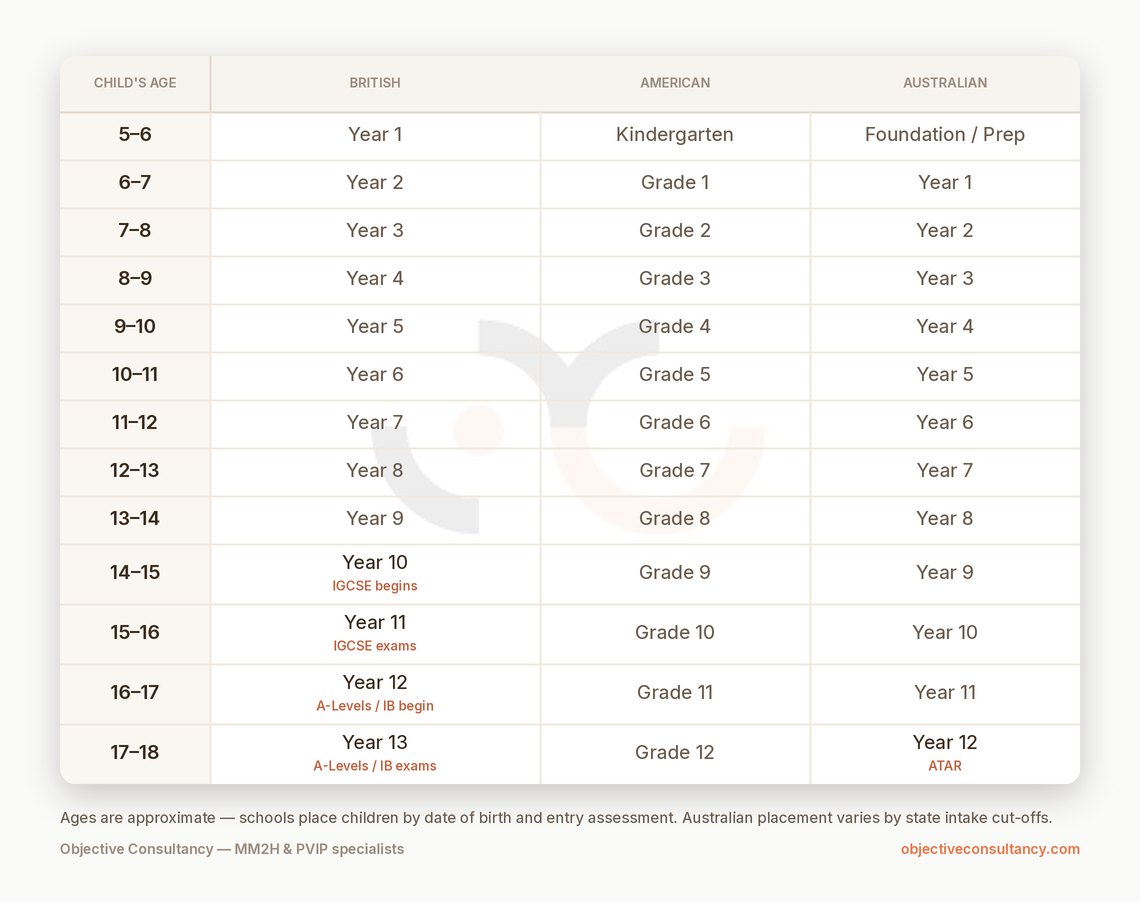
Which year group is my child in?
Here’s how the schooling year converts across these school systems, at a glance:
Timing your move around the school year
Most British, IB, and American schools in Malaysia start their year in August or September, with the year ending in June or July. Australian-curriculum schools start in January.
Mid-year entry is usually possible. Most international schools admit year-round if there's space – one of the underrated advantages of the international sector. But "if there's space" is the operative phrase: popular schools run waiting lists at certain year groups, especially the IGCSE years.
Apply three to six months ahead where you can. Admissions typically involve an application, your child's recent school reports, and an entry assessment — which many schools can now run online before you arrive in Malaysia.
Paperwork in another language needs translating. School reports and birth certificates not in English generally need certified translation – the same requirement your visa application imposes, so it pays to prepare both sets at once.
And connect this to your visa timeline: if your MM2H or PVIP approval is likely to land in, say, March, you can aim your children at an August start with months to spare — or January, if the Australian route fits. This is exactly the sequencing conversation we have with families in consultations.
What it costs
International school fees in Malaysia broadly fall into two bands:
Mid-range schools: roughly RM 20,000–50,000 per child per year
Premium schools: roughly RM 60,000–130,000+ at the senior years.
Fees climb as your child moves up the school – the Year 13 fee, not the Year 4 fee, is the one to stress-test your budget against.
You’ll also have to pay application and assessment fees (typically a few hundred ringgit to about a thousand), a refundable deposit often equal to a term's fees, enrolment or capital levies at some schools, plus uniforms, transport, and (if applicable) English-language (EAL) support charges.
Your visa and your children
Under MM2H, your unmarried children aged 35 and below can be included as dependents, which comfortably covers the entire school journey and well beyond.
Under PVIP, children join as dependents up to age 25. After that, they either become PVIP participants in their own right by topping up the participation fee, or switch to another pass – for a child heading to a Malaysian university, a student pass is the natural route.
Start with the timeline, not the brochure
The families who find this move easiest aren't the ones who visited the most schools – they're the ones who worked out the sequence early: visa timeline, arrival date, school year, intake. The rest becomes a shortlist of two or three schools and a pleasant set of campus tours.
If you're planning a move under MM2H or PVIP with children, that sequencing is exactly what we help with – including introducing families directly to admissions teams. Book a free consultation – no obligation, and you'll leave with a clearer timeline than you arrived with.
School fees, curricula, and admissions requirements are set by individual schools and may change. Visa conditions are set by the Immigration Department of Malaysia.